Vancouver Real Estate Market Outlook 2026: Housing Market Price Forecast
Here is what you don’t already know about the Vancouver real estate market in April, 2026.
When I first looked at Vancouver’s housing market in April, 2026, I couldn’t believe what I was seeing. Sales had dropped 60% from the 2021-2022 peak. Properties were sitting for months. Sellers were finally getting realistic about pricing. If you’ve been waiting for an opportunity to enter the market—or add to your portfolio—2026 might just be your year.
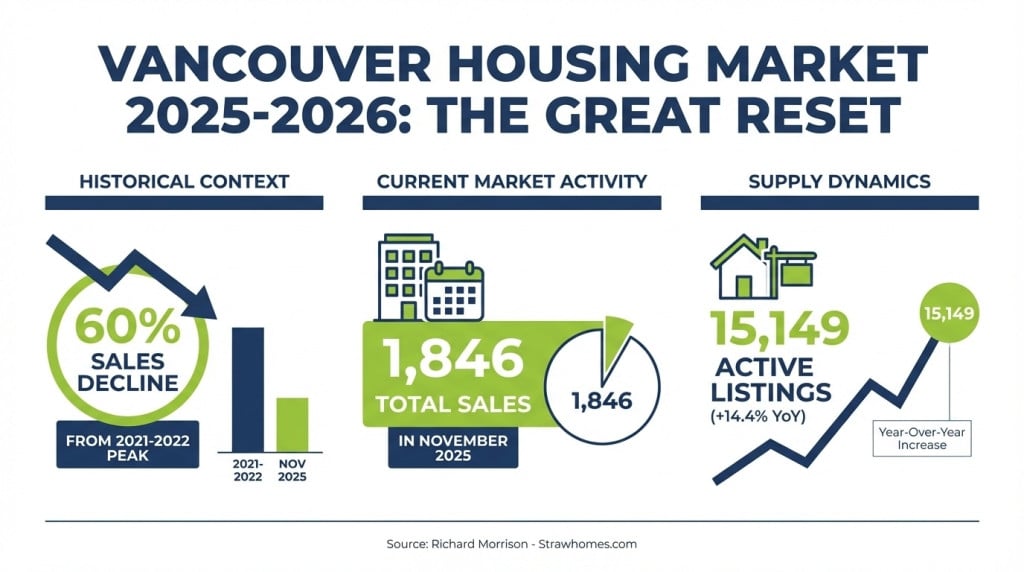
The Vancouver real estate market enters 2026 at a critical inflection point, as highlighted in the latest market trends report. After one of the most dramatic corrections in recent history, the market is transitioning from a prolonged adjustment phase toward stabilization. The combination of declining sales volumes, elevated inventory levels, and persistent affordability challenges creates a complex environment where significant opportunities exist for informed buyers.
Here’s what you need to know about the Vancouver housing market outlook for 2026.
Understanding Market Conditions for April, 2026
The Numbers Tell the Story
- Detached homes in the Greater Vancouver housing market continue to attract interest.: 541 sales (down 13.6% year-over-year)
- Apartments: 945 sales (down 13.2%)
- Townhouses: 350 sales (down 22.4%)
br>Read More: Questions to ask when buying a condo
To put this in perspective, the market peaked at 4,500-5,000 sales monthly during 2021-2022. We’re now averaging 2,000-2,200 sales per month—a 60% decline that represents a complete market reset comparable to the 2008-2009 financial crisis.
Inventory Levels Signal Buyer Advantage
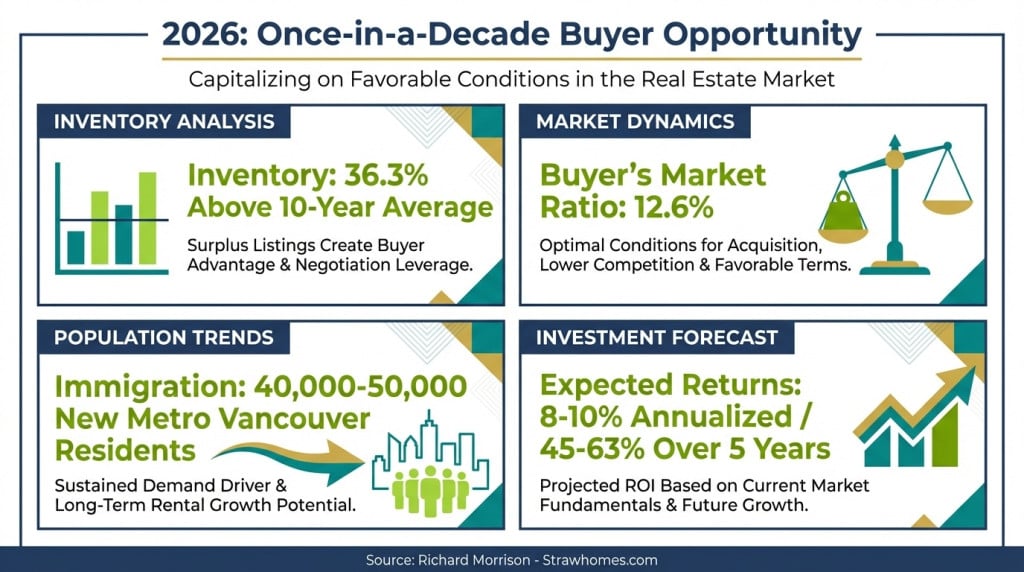
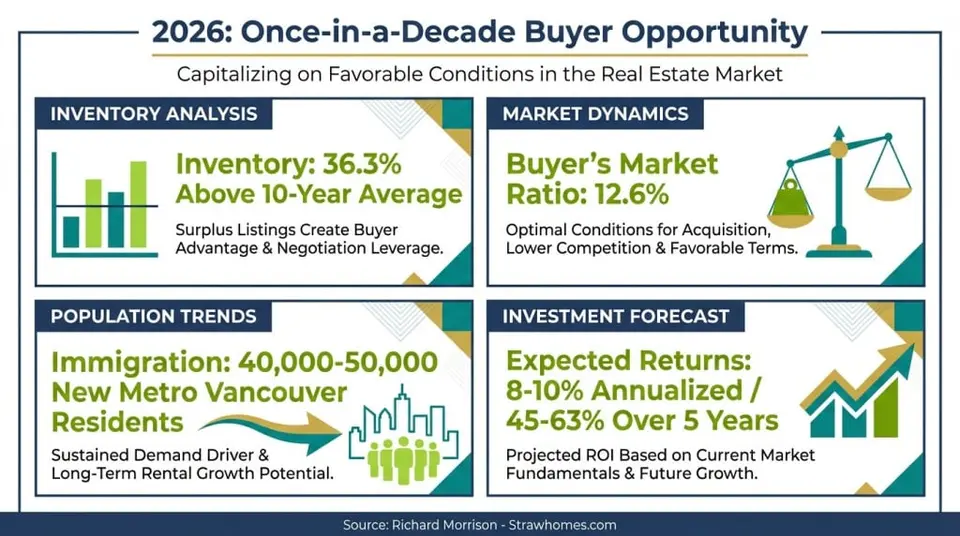
While sales have collapsed, active listings tell another story. November 2025 saw 15,149 properties on the market—up 14.4% from the previous year and 36.3% above the 10-year seasonal average, as reported by the Canadian Real Estate Association. This elevated inventory creates the strongest buyer’s market conditions Vancouver has experienced in 15 years.
The sales-to-active listings ratio currently sits at 12.6%, firmly in buyer’s market territory. Here’s how different property types stack up:
- Detached homes: 9.7% ratio (strong buyer’s market)
- TownhousesThe 13.6% sales-to-listings ratio indicates a shift from balanced to buyer’s market, according to the latest report.
- Apartments: 14.8% ratio (approaching balanced)
Real estate firms use these ratios to gauge market conditions. Below 12% indicates downward pressure on home prices. Between 12-20% signals a balanced market. Above 20% creates upward price pressure—currently absent across all segments in Greater Vancouver.
Housing Prices: Sticky But Softening
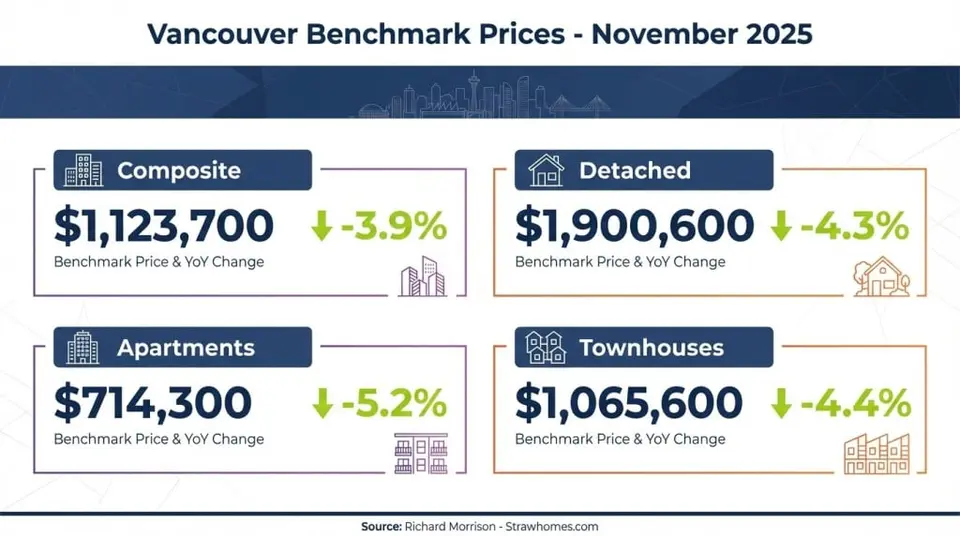
Despite the 60% crash in sales activity, Vancouver housing prices have proven remarkably resilient, declining only 10-15% from peak levels. November 2025 benchmark prices showed:
- Composite benchmark: $1,123,700 (down 3.9% year-over-year)
- Detached homes: $1,900,600 (down 4.3%)
- Apartments: $714,300 (down 5.2%)
- Townhouses: $1,065,600 (down 4.4%)
This price stickiness occurs because sellers remain unwilling to accept significant losses, many owners can afford to wait without becoming forced sellers, and distress levels remain low. Additionally, underlying replacement costs remain high, creating a natural floor under housing prices in Metro Vancouver.
READ MORE: Can you afford a home in Vancouver?
Five Forces Driving Vancouver Housing Market in April, 2026
1. Interest Rates: The Primary Driver
Let’s be clear: interest rates are the number one factor driving Canadian real estate markets and real estate investment in Vancouver. Period.
The Bank of Canada cut rates to 2.5% in September 2025, and 5-year fixed mortgage rates now range from 3.84% to 4.61%—a significant improvement from the 5.5-6.5% rates seen in 2023. For 2026, expect rates to hold steady at 2.5-2.75% through the first half of the year, with a potential additional 0.25% cut in the second half if the economy weakens.
This matters because 76% of Canadian mortgages are renewing by the end of 2026. This massive renewal wave creates both risk (payment shock for some homeowners) and opportunity (forced sales increasing inventory, plus many delayed buyers will finally have certainty to enter the market).
For buyers, this environment demands locking in 5-year fixed mortgage rates immediately. Variable rates offer minimal savings with maximum uncertainty—a poor trade when making a million-dollar decision in the current market trends.
2. Immigration: The Demographic Tailwind
Immigration represents the mega-trend driving Canadian housing demand, and Vancouver remains a primary destination. While federal targets have been reduced from 450,000+ annually to 380,000-400,000 for 2026, these numbers still represent double pre-2015 levels.
Metro Vancouver typically captures 15-18% of national immigration, translating to 40,000-50,000 net new residents expected in 2026. However, there’s a critical lag factor: new immigrants take 12-24 months before purchasing homes. The 2026 market will benefit from pent-up demand from immigrants who arrived in 2024-2025 but delayed purchases during the correction.
Current housing demand represents 2022-2023 immigration cohorts, while 2026 buying activity will reflect more recent arrivals. This creates a buyer pool ready to enter as affordability improves, particularly in East Vancouver, Burnaby, and other immigrant-heavy neighborhoods where average prices historically grow where people go.
3. Affordability: Improving But Still Challenging
Vancouver remains one of Canada’s least affordable real estate markets. To afford that $1,900,600 benchmark detached home requires a household income of roughly $320,000+ annually, a $380,000 down payment, and monthly carrying costs of $9,500-$10,500. That’s realistic for only the top 10-15% of households.
Apartments at $714,300 are more accessible, requiring household income of $120,000-$140,000, a $143,000 down payment, and monthly costs of $3,600-$4,000—affordable to perhaps 30-40% of households.
However, housing affordability is improving in 2026 through four mechanisms:
- Price declines: The 3.9% reduction provides roughly $44,000 in savings on a benchmark home
- Interest rate stability is crucial as 76% of Canadian mortgages are renewing by the end of 2026, according to recent news.: No further rate increases expected
- Increased inventoryGreater negotiating power enables 10-20% discounts on sale prices, a trend noted in recent news.
- Income growth: Wage inflation of 3-4% improves carrying capacity
The result? Entry-level properties and East Side Vancouver condos will recover faster than West Side luxury segments—a pattern consistent with historical market recoveries.
4. Supply Constraints: The Structural Problem
Here’s the uncomfortable truth: government promises 500,000 homes per year, but CMHC projects only 212,550 starts by 2027. That’s a deficit of 287,450 units annually between promise and reality.
Why can’t we build more? Multiple barriers exist:
- Regulatory delays: 31-month average in major Canadian cities; Vancouver’s approval process takes 24-36 months
- Cost escalation: Development costs up 40-60% since 2019
- Step Code requirements: $30,000-$50,000 per unit
- Development charges: Up to $189,000 per unit
- Infrastructure constraints are affecting the availability of properties in the Greater Vancouver housing market.: Water, sewer, power, and schools can’t keep pace
For Metro Vancouver specifically, expect 15,000-18,000 new completions in 2026 with presale launches of 8,000-10,000 units—both reduced due to current market conditions. This creates a net supply deficit of 5,000-8,000 units annually.
Structural undersupply provides a long-term price floor, meaning even if demand weakens, chronic shortage prevents sustained price collapse. However, watch for opportunities as the 5,000+ unsold pre-construction condos create developer distress, potentially offering completed inventory at 10-15% discounts.
5. Economic Factors and Systemic Risks
Several financial warning signs deserve attention heading into 2026:
The $1.4 trillion CLO (Collateralized Loan Obligations) market poses potential Black Swan risk similar to 2008’s mortgage-backed securities, a topic of discussion on Reddit. Default rates are rising in the corporate loan sector, which could trigger credit tightening and reduced lending capacity in Vancouver’s housing market.
Additionally, $16+ billion is frozen across major private REITs (BlackRock, KingSett, Hazelview), signaling broader real estate market stress. Potential forced asset sales in the second half of 2026 could create opportunities for cash-ready buyers.
For 2026, expect BC’s GDP growth of 1.5-2.5%, unemployment of 5.5-6.5%, wage growth of 3-4%, and inflation of 2-3%. Recession risk sits at 25-30%—elevated but not the base case scenario. This economic backdrop suggests keeping 30-50% of investment capital in cash for opportunities that may emerge.
READ MORE: 5 Most Expensive Neighbouhoods in Vancouver
Let’s take a deeper dive into the Vancouver housing market, and what opportunities we can find in April, 2026.
Market Segments: Where Opportunities Hide in April, 2026
Detached Homes: Patient Buyers Win
With a benchmark price of $1,900,600 and sales-to-listings ratio of just 9.7%, detached homes present the strongest buyer’s market in the Vancouver real estate landscape. Expect prices to remain flat to down 2% in the first half of 2026, then recover 2-4% in the second half as buyers return.
Year-end forecast: $1,920,000-$1,960,000 (up 1-3% annually) with sales volume of 7,000-8,500 transactions—a 25-35% increase from 2025 lows.
Geographic variation matters significantly:
- East Side Vancouver: Strongest performance (+3% to +5%) driven by immigrant demand and transit access
- Tri-Cities/Suburbs: Strong growth (+4% to +6%) as the affordability play
- Burnaby/New Westminster: Moderate gains (+2% to +4%) in balanced markets
- West Side Vancouver: Weakest performance (-2% to flat) as luxury segments struggle
The buyer strategy for detached homes should be aggressive in Q1 (submit offers 15-25% below asking), moderate in Q2 (negotiate 10-15% below), selective in Q3 (offer 5-10% below), and normalized in Q4 (return to near-asking offers as seller’s market sentiment builds).
Condos: First to Recover
Vancouver’s condo market shows the most balanced conditions, with apartments recording a 14.8% sales-to-listings ratio—closest to balanced of all property types. This is especially true for rental properties in BC. This suggests condos will be the first segment to recover in 2026.
Current benchmark of $714,300 will likely soften 2-3% in the first half of 2026, then stabilize flat to up 2% in the second half. Year-end forecast: $700,000-$730,000 with sales volume of 12,000-14,000 transactions (up 20-30% from 2025).
Not all condos are created equal:
Older condos (20+ years) offer the best value proposition. Many are cash flow positive, making them attractive to real estate investors with expected price growth of 3-5% in 2026. Rental yields of 4-5% compensate for risks like upcoming special assessments.
Newer condos (0-10 years) typically carry negative cash flow and high strata fees, limiting them primarily to owner-occupiers and downsizers. Expect flat to 2% price growth, but watch for developer completion inventory available at 10-15% discounts.
Pre-construction condos should be avoided entirely. With 5,000+ unsold units creating market overhang and developer distress, the risk of cancellations and litigation is real. However, assignment market opportunities exist at 30-40% below original purchase prices for sophisticated buyers.
Geographic hotspots include Coquitlam Centre/Burquitlam (+4% to +6% due to Evergreen Line effect), Metrotown/Brentwood (+2% to +4% for transit access), and Richmond/Brighouse (+1% to +3% for airport proximity). Downtown Vancouver faces oversupply challenges (-3% to flat).
Townhouses: The Squeezed Middle
Townhouses occupy an uncomfortable position in Vancouver’s housing market—too expensive for first-time buyers stretching from condos, yet less desirable than detached homes for move-up buyers. This results in the highest sensitivity to interest rates and affordability.
Current benchmark of $1,065,600 should stabilize flat to up 1% in the first half of 2026, then recover 3-5% in the second half. Year-end forecast: $1,080,000-$1,110,000 with sales volume of 4,800-5,500 transactions (up 30-40% from 2025’s depressed levels).
The target buyer profile for townhouses consists of young families with 2-3 children, household income of $140,000-$180,000, aged 30-45, motivated by school catchment areas, yard space for kids, and pet ownership.
Geographic strength varies considerably: Surrey/Langley shows strong demand (+4% to +6%) as family-oriented and affordable markets; Tri-Cities moderate demand (+3% to +5%) as commuter markets; Richmond moderate demand (+2% to +4%) focused on school quality; while Burnaby/New Westminster shows weak demand (flat to +2%) due to better condo alternatives.
READ MORE: What is a Good Salary to Live in Vancouver?
Your Quarter-by-Quarter April, 2026 Strategy
Q1 2026: Maximum Opportunity Window
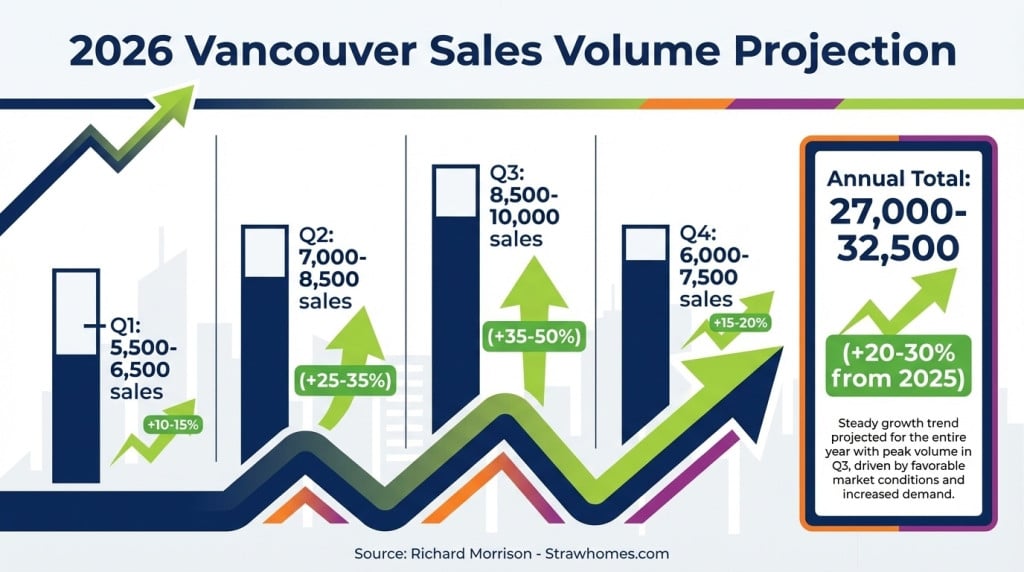
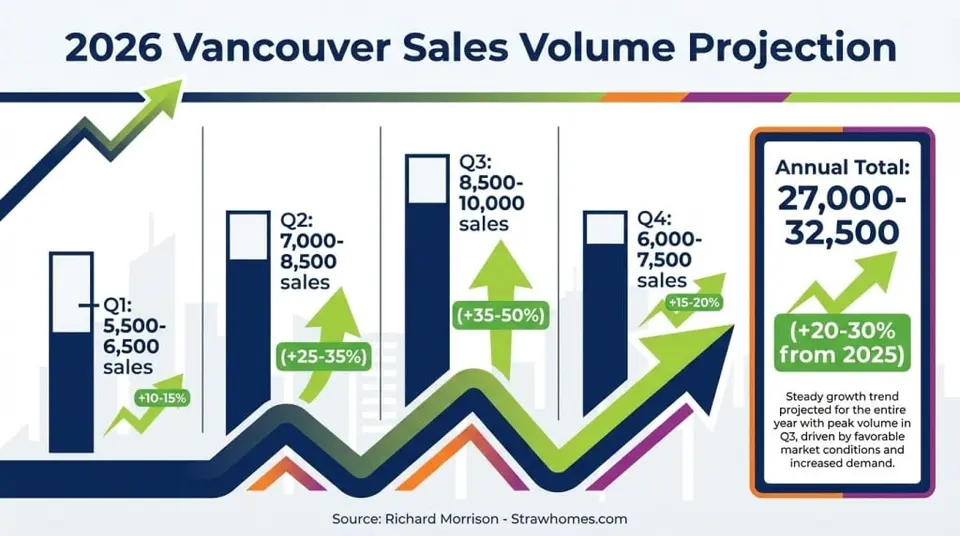
The first quarter represents the patient buyer’s paradise. Expect sales volume of 5,500-6,500 transactions, inventory of 15,000-16,000 active listings, and a sales-to-listings ratio of 11-13% firmly in buyer’s market territory.
Market sentiment shows cautious but opportunistic buyers, increasingly realistic sellers, and media headlines about housing market struggles. This creates maximum negotiating leverage with properties sitting 60-90 day on the market.
Optimal strategy: Submit 10-15 lowball offers targeting 15-25% below asking for luxury properties or 10-15% below for mid-range homes. Lock 5-year fixed mortgage rates immediately. Best opportunities include developers clearing completed inventory at 10-15% discounts, estate sales, and motivated sellers facing carrying costs.
Q2 2026: The Transition Begins
Sales volume jumps to 7,000-8,500 transactions (up 25-35% from Q1) as inventory declines to 13,000-14,500 active listings. The sales-to-listings ratio hits 14-17%, indicating balanced market conditions emerging.
Buyer urgency increases with “don’t want to miss the bottom” psychology replacing fear. Sellers gain confidence but remain flexible. Early Q2 (April-May) still offers negotiation opportunities 5-10% below asking, but by June, asking price becomes standard with occasional multiple offers emerging.
This represents the last chance for strong negotiation leverage before the market fully transitions. Markets recover faster than they fall, and recovery tends to be V-shaped rather than U-shaped.
Q3 2026: Recovery Confirmation
Sales volume reaches 8,500-10,000 transactions (up 35-50% year-over-year) as inventory normalizes to 11,000-12,500 active listings. The sales-to-listings ratio of 17-20% approaches seller’s market threshold with price movement of 2-4%—the strongest quarterly gain of the year.
Competitive buyers act quickly, confident sellers price at or above market, and multiple offers return across segments. For buyers, Q3 represents “last call” for balanced market conditions. For sellers, listing in September captures recovering demand while inventory remains reasonable.
The 76% mortgage renewal wave peaks in 2026, and by Q3, many homeowners will have navigated renewals, removing uncertainty that suppressed buying in 2024-2025.
Q4 2026: Setting Up 2027
Traditional seasonal decline brings sales volume to 6,000-7,500 transactions, but inventory falls to 9,000-11,000 active listings—below the 10-year average. Sales-to-listings ratio of 18-22% confirms balanced to seller’s market conditions in the Greater Vancouver housing market.
Annual sales reach approximately 27,000-32,500 transactions (up 20-30% from 2025), annual price change shows 1.5-3.5% gains, and market classification shifts from buyer’s to balanced market according to the latest market trends report. This sets the stage for a more traditional seller’s market in 2027 with inventory constraints, multiple offers becoming standard, and price appreciation accelerating to 5-8% annually.
Key Risks to Monitor
While 2026 presents significant opportunities, several risks deserve consideration:
Economic recession A prediction of (25-30% probability) could push sales down another 20-30% and prices down 5-10%, echoing concerns from August 2025. Mitigation requires maintaining 50% cash reserves and focusing on cash-flowing properties only.
Immigration reduction (40-50% probability) to 250,000-300,000 annually would reduce population growth by 30%, soften rental demand, and impact investor returns. Focus on owner-occupier properties in family neighbourhoods rather than investor-dependent or student-heavy markets.
Interest rate resurgence (15-20% probability) from renewed inflation could collapse affordability and trigger price declines of 10-15%. Lock 5-year fixed rates immediately and stress test at +2% rates.
Government policy shocks (10-15% probability) like wealth taxes or elimination of principal residence exemption could trigger panic selling. Use principal residence exemption fully and maintain geographic diversification.
Structural oversupply (<5% probability) from successfully building 500,000 homes annually appears virtually impossible given 31-month approval delays, 40-60% cost escalation since 2019, and infrastructure capacity limits.
The Bottom Line: 2026 Action Plan
Metro Vancouver real estate in 2026 represents a once-in-a-decade opportunity for patient, well-capitalized buyers and investors. The market has established a durable bottom with sales volume stabilized at depressed levels, inventory elevated but no longer rising, and price declines moderating.
For first-time buyers: Target older condos near SkyTrain stations in the $500K-$650K range during Q1-Q2 2026. Submit lowball offers on properties listed 60+ days. Finance with 10-20% down and 5-year fixed rates under 4.5%. Build $150K-$200K equity over five years to trade up.
For move-up families: Target 3-4 bedroom detached homes with suite potential in East Vancouver, Burnaby, or Tri-Cities for $1.3-$1.7M. Time purchases in Q1 for aggressive offers or Q4 for tax planning. Suite income can offset $1,500-$1,800 monthly, creating positive cash flow.
For investors: Deploy 40-50% of capital in Q1 2026, submitting 15-20 offers and accepting 1 in 10-15. Target 2-3 properties mixing detached and older condos in the $1.2-$1.6M range. Maintain 30-50% cash reserves for opportunities emerging in the second half of 2026. Expected returns: 45-63% over five years (8-10% annualized).
For luxury buyers, the average prices in the Greater Vancouver housing market remain a point of interest.: Wait until Q2-Q3 2026 when sellers become more realistic after failed Q1 attempts. Consider “rentvesting”—buying investment property while renting luxury accommodations—to build equity while enjoying desired lifestyle.
The Vancouver housing market in 2026 isn’t just recovering—it’s resetting to create the next generation of wealth builders. The combination of rock-bottom sales volumes, elevated inventory, maximum negotiating leverage, favorable financing, structural undersupply, and continued immigration demand creates asymmetric returns with limited downside risk (5-10% further decline) and substantial upside potential (30-50% over five years).
The question isn’t whether to participate in the Vancouver real estate market in 2026. The question is how aggressively to deploy capital before this once-in-a-decade opportunity passes.

Let's Chat! Looking for a REALTOR® who can exceed your expectations? Look no further than Richard Morrison! His mission is to serve without limit & provide solutions that cater to your core needs.
• 20+ Years of Experience
• Medallion Member
• RE/MAX Hall of Fame

Latest Properties Added
| Property | Size | Price | Date Listed |
|---|---|---|---|
| 2-2509 Kitchener Street, Vancouver | 1,284 sqft | $1,298,800 | Sep 12, 2026 |
| 1406-938 Smithe Street, Vancouver | 761 sqft | $799,000 | Sep 11, 2026 |
| 2802-1033 Marinaside Crescent, Vancouver | 583 sqft | $639,000 | Sep 11, 2026 |
| 386 45th Avenue, Vancouver | 1,762 sqft | $2,199,900 | Sep 10, 2026 |
| 207-378 45th Avenue, Vancouver | 1,329 sqft | $1,478,900 | Sep 10, 2026 |
| 108-378 45th Avenue, Vancouver | 745 sqft | $879,900 | Sep 10, 2026 |
| 1-1958 60th Avenue, Vancouver | 1,463 sqft | $1,899,900 | Sep 9, 2026 |
| 2-1956 60th Avenue, Vancouver | 1,463 sqft | $1,899,900 | Sep 9, 2026 |
| 1-1956 60th Avenue, Vancouver | 1,463 sqft | $1,899,900 | Sep 9, 2026 |
| 6222 Logan Lane, Vancouver | 1,622 sqft | $1,250,000 | Sep 7, 2026 |
| 4339 Granville Street, Vancouver | 4,672 sqft | $6,500,000 | Sep 11, 2026 |
| 104-5281 Oakmount Crescent, Burnaby | 839 sqft | $598,000 | Sep 11, 2026 |
Start your search with Richard Morrison, Top Award Winning Vancouver Realtor
Contact Richard Morrison Top Vancouver Realtor today to find a Vancouver houses for sale and Vancouver condos for sale. Also check out Burnaby houses for sale or maybe Burnaby condos for sale. If you prefer North Shore, take a look at our listings in North Vancouver houses for sale and North Vancouver condos for sale.