Rent-to-Own Homes in BC: How Does Renting to Owning Work?
When I first heard about rent-to-own homes, I thought it sounded too good to be true. Pay rent and eventually own the place? But after diving deep into how rent-to-own works in BC Canada, I realized this path to homeownership is far more strategic—and legitimate—than most people imagine.
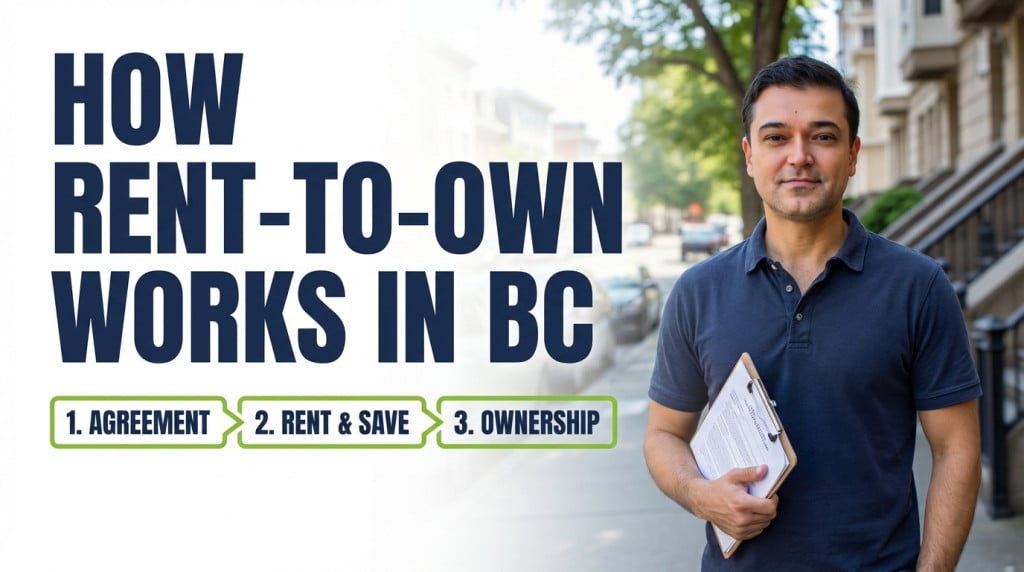
Rent-to-own in BC works by renting a home with an option to buy it later, usually within 2–5 years. Buyers pay above-market rent, with a portion credited toward a future down payment, plus an upfront option fee. The purchase price is set in advance, and buyers must qualify for a mortgage at the end of the term.
If you’re struggling to save for a traditional down payment or can’t quite qualify for a mortgage yet, you’re not alone. Rent-to-own programs offer a proven solution that lets you rent a home today while working towards ownership tomorrow.
What Is Rent-to-Own and How Does It Work in BC?
Rent-to-own is a type of agreement that combines renting with the option to purchase a property at the end of a predetermined lease period. Unlike a traditional rental agreement where your monthly rent simply pays for housing, a rent-to-own contract allocates a portion of your monthly rent payments toward building equity and eventually purchasing the home.
You sign a rent-to-own agreement (also called a lease-option agreement or lease-purchase agreement) that gives you the exclusive right to buy the property after living in it for a specified lease term—typically 1 to 5 years. During this time, you’re test-driving homeownership while preparing your finances to secure a mortgage. You’re not just throwing money away—you’re investing in your future home ownership with every monthly payment.
The Three Core Components of Every Rent-to-Own Agreement
1. The Option Fee (Your Foot in the Door)
When you enter a rent-to-own program, you’ll pay an upfront option fee—typically 2-5% of the home’s purchase price. In Vancouver’s competitive housing market, where home prices continue climbing, this option fee protects you by locking in today’s purchase price for tomorrow’s sale. If you complete the purchase, it usually gets applied toward your down payment. Understanding how deposits work when buying a house is crucial before entering any agreement.
2. Monthly Rent Payments (Building Your Future)
Your monthly rent in a rent-to-own arrangement consists of base rent (comparable to current market rates) plus rent credits—an additional amount (typically $200-$800+) that accumulates toward your down payment.
For example, if your monthly rent is $2,500 and $400 goes toward rent credits, you’re building $4,800 annually. Over a 3-year lease period, that’s $14,400 in equity over time—plus your initial option fee. Every rent payment on time in a rent-to-own contract moves you closer to owning a home. If you’re debating whether to continue renting, check out our guide on whether you should sell your house or rent it out.
3. The Purchase Price Agreement
Most rent to own agreements in BC use fixed prices (set when you sign), appraised values (determined at the end of the agreement), or appreciation formulas (increasing by predetermined percentages annually). Understanding which pricing model your rent-to-own contract uses is essential. Learn more about what factors affect property values to make informed decisions.
Types of Rent-to-Own Agreements in British Columbia
Lease-Option Agreement (More Flexible): Gives you the option to purchase the home at the end of the lease without legal obligation. You can walk away if circumstances change, though you’ll lose your option fee and accumulated rent credits, which can affect your ability to buy the home later.
Lease-Purchase Agreement (Committed Path): Legally binds you to purchase the property when the lease term ends. It offers less flexibility but sometimes better terms since the seller has more certainty.
Most rent-to-own programs in Vancouver and throughout BC use the lease-option structure, giving tenants more security while they work towards homeownership.
Who Benefits Most from Rent-to-Own in BC Canada?
Rent-to-own helps specific groups facing traditional barriers:
First-time buyers with poor credit: The lease period gives you time to rebuild your credit score while living in your future home. Explore our first-time home buyer tips in BC for more insights.
Self-employed individuals: A rent to own arrangement gives you time to establish a longer track record of consistent earnings for mortgage approval.
New immigrants to Canada: Rent-to-own provides a path to homeownership while you establish your financial footprint. Learn whether you can buy a house in Canada on a work permit.
Those building their down payment should consider the option to buy as a viable path to homeownership.: Rent to own programs automatically build your down payment through rent credits. Check out average down payment requirements in Canada to set realistic goals.
People recovering from financial setbacks: The lease period provides breathing room to stabilize your finances after bankruptcy, divorce, or other challenges.
The Financial Mechanics: Breaking Down the Numbers
Let’s walk through a realistic BC rent-to-own scenario:
Home value: $650,000br>Option fee: 3% = $19,500br>Lease term: 3 yearsbr>Monthly rent: $2,800br>Rent credit: $500 per month
At the end of 3 years, you may have the option to buy the home if you meet certain conditions.
- Accumulated rent credits: $18,000
- Option fee: $19,500, which can be credited towards your down payment if you choose to buy the home.
- Total toward down payment: $37,500
This represents approximately 5.8% down—often enough to qualify for a mortgage if your credit score and income meet requirements. Compare this to traditional renting where you’d have paid $100,800 with nothing to show for it.
How to Qualify for a Rent-to-Own Program in British Columbia
Rent-to-own has more flexible entry requirements than traditional mortgages:
- Some down payment savings can help you secure the option to buy the home.: The option fee (2-5% of purchase price)
- Stable income: Proof you can afford monthly payments
- Reasonable credit: Many programs accept scores as low as 550-600
- Clean rental history: Proof you pay rent on time
- Employment verification: Steady job or income source
Familiarize yourself with essential real estate terms in Canada to navigate conversations confidently with your landlord about the lease agreement.
Your Responsibilities During the Lease Period
In most rent-to-own contracts, you’re responsible for maintenance and repairs like a homeowner would be. This includes routine maintenance, property insurance (sometimes), utilities, and occasionally property taxes. Understanding questions to ask when renting a house can help clarify maintenance expectations upfront.
Working Towards Mortgage Qualification: Your Action Plan
Months 1-6: Review credit reports, dispute errors, set up automatic payments, create budgets
Months 7-18: Pay down high-interest debt, keep credit utilization below 30%, avoid new credit applications, build positive payment history
Months 19-30 are crucial for making timely rent payments to secure your option to buy.: Meet with mortgage brokers, get pre-qualified, save additional funds beyond rent credits, gather documentation
Final Months: Order home inspections, complete mortgage applications, arrange for title insurance and legal representation, finalize closing details
The Government of Canada offers various first-time home buyer programs in BC that might apply to your situation.
Red Flags: Protecting Yourself from Rent-to-Own Scams
Watch for these warning signs:
🚩 Unrealistic promisesbr>🚩 Unclear contract terms—review our guide on the contract of purchase and sale in BCbr>🚩 Pressure tacticsbr>🚩 Above-market purchase pricesbr>🚩 No legal representation—check typical legal fees for buying a house in BCbr>🚩 Unclear rent credit documentationbr>🚩 No exit strategy
Advantages and Drawbacks of Rent-to-Own
Benefits of rent-to-own include:
✅ Immediate housing security while preparing to purchasebr>✅ Locked-in pricing protecting against rising home pricesbr>✅ Test the property before committingbr>✅ Build equity while rentingbr>✅ Time to improve finances and creditbr>✅ Test neighborhood compatibility—explore best neighborhoods in Vancouver for familiesbr>✅ Flexible qualification requirementsbr>✅ Automatic down payment savings
Potential drawbacks:
❌ Lose option fee and rent credits if you can’t secure a mortgagebr>❌ Responsible for maintenance costsbr>❌ Limited flexibility to relocatebr>❌ Risk of being locked into above-market prices if values dropbr>❌ Understanding how rising interest rates affect the housing market and the option to buy the home helps anticipate challenges
Weigh the pros and cons of rent-to-own homes carefully before deciding.
How BC’s Real Estate Market Affects Rent-to-Own Opportunities
Rent-to-own works best when:
- Home prices are rising rapidly
- Mortgage rates are high but expected to decrease
- Housing supply is limited, making it challenging to find a rent-to-own option that allows you to build equity over time.
- You’re competing in a hot market—learn how to buy a home in a seller’s market in Canada
The current market value varies dramatically by region.
Finding Legitimate Rent-to-Own Programs in British Columbia
Look for specialized rent-to-own companies, real estate agents who understand what a real estate agent does for buyers, property management companies, private homeowners, and verified online marketplaces.
Avoid classified ads with unrealistic terms, programs charging large finder’s fees, listings without detailed contract terms, and anyone unwilling to allow lawyer review.
Legal Considerations and Contract Essentials
Every rent-to-own contract in BC should specify: purchase price determination, lease duration, monthly rent breakdown, option fee details, maintenance responsibilities, property tax responsibility, insurance requirements, exit clauses, default conditions, and seller’s obligations.
A real estate lawyer should review your rental agreement before signing. Understanding legal fees for selling a house in BC gives perspective on standard legal costs.
Tax Implications of Rent-to-Own in British Columbia
During the lease period, you’re considered a tenant for tax purposes and cannot claim the home as your principal residence yet, but you can work towards the option to buy. At purchase, you may qualify for first-time home buyer incentives. Review BC property transfer tax exemptions for potential savings and check BC GST rebate eligibility for new homes if purchasing new construction.
Alternatives to Rent-to-Own in BC
Consider first-time home buyer programs, family-assisted mortgages including buying a house jointly with parents in Canada, non-traditional lenders, saving strategies, or fractional ownership in some BC markets.
Frequently Asked Questions About Rent-to-Own in BC
Is rent-to-own more expensive than regular renting?
Yes—monthly payments are typically 10-30% higher because you’re building equity. That extra money is your investment in buying the house.
What happens if I can’t get a mortgage at the end of the lease period?
Most agreements allow you to walk away, but you’ll forfeit your option fee and accumulated rent credits. Understanding how long it takes to buy a house in BC helps set realistic timelines.
Can the seller back out of the agreement?
If properly structured, your rent-to-own contract legally binds the seller to sell at agreed terms if you exercise your option to purchase.
What if the property needs major repairs during my lease?
Review your contract carefully. Get this clarified before signing and consider getting inspections from professionals. Learn how to find a good home inspector to protect your interests.
Taking the First Step: Your Rent-to-Own Action Plan
Week 1: Assess your readiness—review credit, calculate affordability, evaluate commitment
Weeks 2-3: Research your market—investigate home prices, compare programs, connect with successful rent-to-own buyers
Week 4: Assemble your team—find a lawyer, mortgage broker, financial advisor. Review qualities of a good real estate agent if working with an agent.
Weeks 5-8 are important for establishing a positive relationship with your landlord.: View properties and review agreements—tour homes, request detailed terms, have lawyer review contracts, arrange inspections
Weeks 9-10: Negotiate and sign—negotiate terms, document everything in writing, keep all paperwork
Throughout lease period: Execute improvement plan—follow credit improvement timeline, make every rent payment on time, document maintenance, and communicate with your mortgage broker to ensure you can buy the home.
The Bottom Line: Is Rent-to-Own Right for You?
Rent-to-own in BC Canada works best for disciplined individuals committed to improving their financial situation and confident they’ll qualify for a mortgage within the lease term.
Rent-to-own is probably right for you if: ✅ You have stable income but credit challengesbr>✅ You’re committed to a 2-5 year planbr>✅ You can afford monthly rent plus rent creditsbr>✅ You have 2-5% saved for an option feebr>✅ You’re ready for homeowner responsibilities
Rent-to-own probably isn’t right if you don’t intend to live in the home long-term. ❌ You need maximum flexibility to relocatebr>❌ Your income is highly unstablebr>❌ You can’t afford higher-than-market monthly paymentsbr>❌ You already qualify for traditional financing—consider the option to buy the home through a rent-to-own agreement. how to buy a house without a realtor in Canada
The BC housing market presents real challenges for aspiring homeowners. Understanding the cost of selling a house in BC Canada helps you appreciate the full financial picture of homeownership.
The key is entering any rent-to-own arrangement with eyes wide open, proper legal advice, and realistic assessment of your ability to complete the purchase. Done right, rent-to-own can transform your housing situation from renting to owning—putting you on solid ground in BC’s competitive real estate market.
Your path to homeownership doesn’t have to follow the traditional route. Sometimes the alternative path—though less traveled—leads exactly where you need to go.

Let's Chat! Looking for a REALTOR® who can exceed your expectations? Look no further than Richard Morrison! His mission is to serve without limit & provide solutions that cater to your core needs.
• 20+ Years of Experience
• Medallion Member
• RE/MAX Hall of Fame

Latest Properties Added
| Property | Size | Price | Date Listed |
|---|---|---|---|
| 141 27th Street, North Vancouver | 1,651 sqft | $1,899,000 | Sep 13, 2026 |
| 2-2509 Kitchener Street, Vancouver | 1,284 sqft | $1,298,800 | Sep 12, 2026 |
| 1406-938 Smithe Street, Vancouver | 761 sqft | $799,000 | Sep 11, 2026 |
| 2802-1033 Marinaside Crescent, Vancouver | 583 sqft | $639,000 | Sep 11, 2026 |
| 386 45th Avenue, Vancouver | 1,762 sqft | $2,199,900 | Sep 10, 2026 |
| 207-378 45th Avenue, Vancouver | 1,329 sqft | $1,478,900 | Sep 10, 2026 |
| 108-378 45th Avenue, Vancouver | 745 sqft | $879,900 | Sep 10, 2026 |
| 1-1958 60th Avenue, Vancouver | 1,463 sqft | $1,899,900 | Sep 9, 2026 |
| 2-1956 60th Avenue, Vancouver | 1,463 sqft | $1,899,900 | Sep 9, 2026 |
| 1-1956 60th Avenue, Vancouver | 1,463 sqft | $1,899,900 | Sep 9, 2026 |
| 6222 Logan Lane, Vancouver | 1,622 sqft | $1,250,000 | Sep 7, 2026 |
| 4339 Granville Street, Vancouver | 4,672 sqft | $6,500,000 | Sep 11, 2026 |
Start your search with Richard Morrison, Top Award Winning Vancouver Realtor
Contact Richard Morrison Top Vancouver Realtor today to find a Vancouver houses for sale and Vancouver condos for sale. Also check out Burnaby houses for sale or maybe Burnaby condos for sale. If you prefer North Shore, take a look at our listings in North Vancouver houses for sale and North Vancouver condos for sale.