Minimum Down Payment on a House in BC: How Much Down Payment on Average
When I first started helping clients navigate the BC housing market, I thought down payments were straightforward – save 20%, make your purchase, and you’re done. But after working with hundreds of buyers across Greater Vancouver and the Lower Mainland, I realized the truth about minimum down payment requirements is far more nuanced than most people imagine.
Minimum down
The housing landscape in BC has evolved dramatically. Today’s buyers face unique challenges, from skyrocketing prices to complex mortgage rules. But here’s the good news: you don’t always need 20% down to purchase a home.
Understanding Your Minimum Down Payment in BC On A House in BC
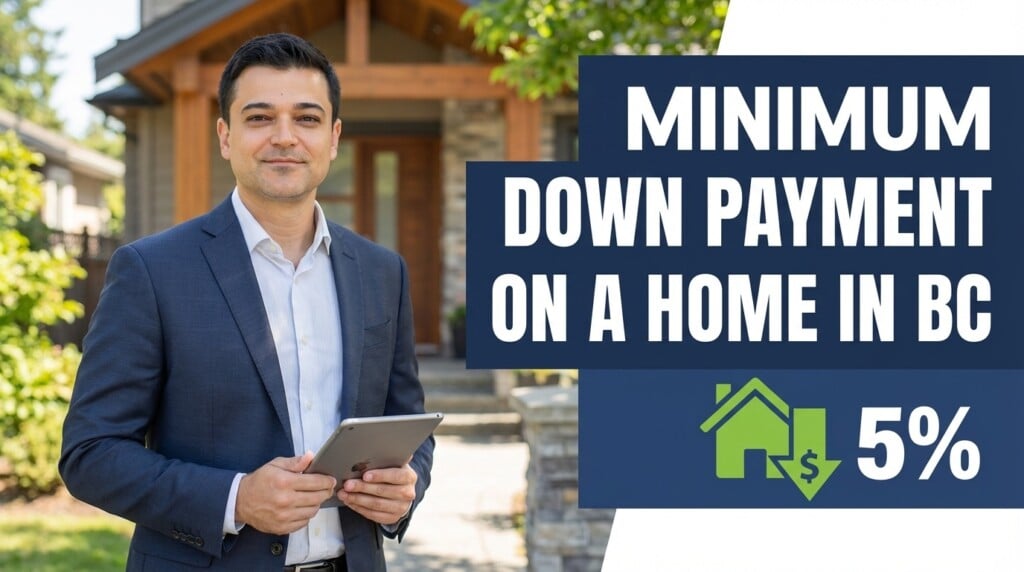
Let’s cut through the confusion right away. The minimum down payment to buy a home in BC is 5%, and it depends entirely on your purchase price. This isn’t arbitrary – it’s mandated by federal regulations designed to protect both buyers and lenders.
For homes priced at $500,000 or less, you’ll need just 5% of the purchase price. That’s it. If you’re eyeing a $400,000 condo in Burnaby, you’re looking at a minimum of $20,000 down. Suddenly homeownership doesn’t seem quite so impossible, does it?
But here’s where it gets slightly more complex. For properties between $500,000 and $999,999, you’ll need 5% on the first $500,000, plus 10% on the remaining amount. Let me break this down with a real example.
Sarah wanted to buy a townhouse in Coquitlam listed at $750,000. Her calculation looked like this:
- 5% of $500,000 = $25,000
- 10% of $250,000 (the remaining amount) = $25,000
- Total minimum down payment: $50,000
For luxury homes priced at $1 million or more, you’ll need a full 20% down payment. No exceptions. That’s $200,000 for a million-dollar home. These are the rules set by the Government of Canada to ensure financial stability in the housing market.
What Exactly Is This Upfront Money You’re Putting Down?
Think of your down payment as your initial equity stake in the property. It’s the amount of money you pay upfront at the time of purchase, reducing the mortgage amount you need to borrow from your mortgage lender.
Here’s a critical distinction many first-time home buyers miss: your deposit and your down payment aren’t the same thing, though they’re related. When you make an offer on a home in BC, you typically provide a deposit (usually 5% of the purchase price) held in trust. This deposit becomes part of your total down payment when the deal closes.
I’ve seen buyers scramble at closing because they didn’t realize they needed additional funds beyond their initial deposit. Don’t make that mistake.
The Real Cost: How Your Initial Investment Shapes Your Mortgage & Mortgage Insurance
Your down payment affects far more than just your initial cash outlay. It fundamentally changes your entire homeownership experience.
Monthly Payment Impact
The more you put down, the less you borrow. A larger down payment means lower monthly mortgage payments, less interest paid over the life of your mortgage, and faster equity building.
Let’s say you’re buying a $600,000 home in Vancouver. Compare these scenarios:
Scenario A: Minimum Down Payment ($35,000)
- Mortgage amount: $565,000
- Approximate monthly payment: $3,200 (at 5% interest)
Scenario B: 20% Down Payment ($120,000)
- Mortgage amount: $480,000
- Approximate monthly payment: $2,720 (at 5% interest)
That’s nearly $500 per month in savings. Over 25 years, you’re talking about significant interest savings.
The Mortgage Loan Insurance Factor Nobody Talks About
Here’s something that catches many buyers off guard: if you put down less than 20%, you’re required to pay mortgage loan insurance (also called mortgage default insurance). This isn’t optional.
Mortgage default insurance protects the mortgage lender – not you – in case you can’t make your payments. The primary insurer in Canada is CMHC (Canada Mortgage and Housing Corporation), though Sagen and Canada Guaranty also provide coverage.
The mortgage loan insurance premiums range from 0.60% to 4.50% of your mortgage amount, depending on how much you put down. The less you put down, the higher your premium. For that $600,000 home with 5% down:
- Mortgage amount: $570,000
- Insurance premium (4.00%): $22,800
- Total amount you’re borrowing: $592,800
Most buyers add this premium to their mortgage rather than paying upfront, meaning you’ll pay interest on the insurance over the entire amortization period.
When you put 20% or more down? No insurance required. Your mortgage lender considers you lower risk because you have significant equity in your home from day one.
BC’s Unique Requirements and Additional Costs For Home Buying
British Columbia follows federal mortgage rules, but our market conditions create unique considerations. The minimum down payment requirements apply across Canada, but purchasing in BC comes with additional costs that affect your total cash needs.
Beyond the Down Payment: Other Upfront Costs
Every buyer I work with asks: “Is the down payment all I need?” The answer is always no. You’ll also need funds for:
- Property Transfer Tax: In BC, this is substantial. For a $600,000 home, you’ll pay approximately $11,000. First-time buyers may qualify for an exemption on homes up to $835,000, which can save you thousands.
- Legal Fees: Budget $1,500-$2,500 for legal services when buying.
- Closing Costs: Property taxes, strata fees (for condos), title insurance, and more typically add up to 1.5-3% of your purchase price.
When you’re calculating how much you need, add at least 2-4% of the purchase price beyond your down payment to cover these expenses.
Regional Variations Across BC
While the minimum down payment rules are consistent province-wide, the practical reality varies dramatically by region.
In Greater Vancouver or North Vancouver, where the average home price pushes well above $1 million, that 20% requirement becomes a serious barrier. You’re looking at $200,000+ just for the down payment.
In other BC markets – think Kamloops or Kelowna – where prices are more moderate, that 5-10% minimum down payment range is far more achievable. A $450,000 home only requires $22,500 down, which is substantially more accessible for many buyers.
Why the 20% Threshold Changes Everything: Larger Down Payment
There’s a reason I keep emphasizing that 20% mark. It’s not just about avoiding insurance premiums (though that’s huge). Putting 20% or more down signals to lenders that you’re a lower-risk borrower.
Benefits of Meeting or Exceeding 20%
Lower Interest Rates: Lenders often offer better rates to borrowers with larger down payments. Even a 0.25% difference in your interest rate can save tens of thousands over your mortgage term.
No High-Ratio Mortgage Restrictions: When you borrow more than 80% of a home’s value (less than 20% down), you have what’s called a high-ratio mortgage. These come with stricter qualification requirements.
Greater Equity Position: More equity from day one means you’re better positioned if property values fluctuate. You’re less likely to be underwater on your mortgage if the market dips.
Negotiating Power: Sellers often view offers with larger down payments more favorably. In competitive markets, this can be the difference between winning and losing a bidding war.
I worked with a couple in Richmond who initially planned to put 10% down on a $900,000 home. After seeing how much they’d save on insurance and interest, they delayed their purchase by six months, saved an additional $60,000, and put 20% down instead. Their monthly mortgage payment is nearly $600 less than it would have been.
Understanding the price of your home, minimum down payment required, and payment requirements in BC is crucial whether you’re a first time home buyer or experienced investor. The minimum down payment is 5% for homes under $500,000, while properties up to 1.5M require a blended calculation, and anything above needs payment of 20% or more. With less than 20% down, you’ll need a high ratio mortgage and a specific type of insurance, where insurance premiums range from 0.6% to 4% of your amount of your mortgage.
Building Your Reserve: Strategies for Accumulating Funds
Let’s be honest – saving tens of thousands of dollars isn’t easy, especially in BC’s expensive housing market. Recent data shows it can take years to save enough for a Vancouver purchase. But it’s not impossible.
Utilize Tax-Advantaged Accounts
The Home Buyers’ Plan (HBP) allows first-time buyers to withdraw up to $60,000 from their Registered Retirement Savings Plan (RRSP) tax-free for a home purchase. Couples can each withdraw $60,000, giving you $120,000 in potential down payment funds.
The catch? You must repay this amount over 15 years. But it’s interest-free, and it allows you to leverage your retirement savings for homeownership now.
I’ve had clients strategically contribute to their RRSP for 2-3 years before buying specifically to maximize their HBP withdrawal. You get the RRSP tax deduction when you contribute, then use that refund to build your payment fund even further.
Government Assistance Programs
The federal government offers shared-equity mortgages through various first-time buyer programs. While these have income and property price limits that can be restrictive in BC, they’re worth investigating if you qualify.
Alternative Savings Approaches
High-Interest Savings Accounts: Park your down payment fund in a tax-free savings account (TFSA) where growth isn’t taxed.
Gift from Family: Many BC buyers receive help from parents or relatives. Just be aware that your lender will require a gift letter confirming the money doesn’t need to be repaid.
Increase Income: Consider side hustles, overtime, or career advancement specifically focused on boosting your savings rate. Every extra $500 per month is $6,000 annually towards your goal.
Real Numbers: How Much Down Payment is Required For Vancouver
Let’s put this all together with a comprehensive example for someone buying in BC.
Purchase Price: $650,000 (typical for a 2-bedroom condo in many Lower Mainland markets)
Minimum Down Payment Calculation:
- 5% of first $500,000 = $25,000
- 10% of remaining $150,000 = $15,000
- Total: $40,000
Additional Costs:
- CMHC insurance premium (3.10% on $610,000 mortgage): $18,910 (added to mortgage)
- Property Transfer Tax: $13,000 (first-time buyer may be exempt)
- Legal fees: $2,000
- Home inspection: $600
- Other closing costs: $3,000
Total Cash Required: $58,600 (or $45,600 if you qualify for the first-time buyer property transfer tax exemption)
That’s the reality. To buy a $650,000 home with the minimum down payment, you need roughly $46,000-$59,000 in cash.
Many first-time buyers struggle to save for a down payment, but understanding the minimum amount needed towards the purchase helps with affordability planning. Whether paying via lump sum or calculating if your payment amount fits your budget to make your mortgage payments, proper planning prevents you from defaulting on commitments. Your mortgage lender in case you default on your mortgage will require this protection.
Special Considerations for Different Buyer Types in The Home Buying Process
Self-Employed Buyers
If you’re self-employed or have a poor credit history, you’ll face additional scrutiny from lenders. Many self-employed individuals in BC have found that putting down 20% or more significantly improves their mortgage approval odds and rates.
Investment Properties
Buying a second property or investment home? Lenders may require a larger down payment – often 20% minimum, regardless of price. The rules for primary residences don’t apply to investment properties.
Credit Challenges
A poor credit history doesn’t necessarily disqualify you, but it makes everything harder. A larger down payment can help offset credit concerns and demonstrate your commitment to lenders.
Common Questions About Initial Payments in BC
Can you put down less than 5%?
No. The absolute minimum down payment allowed in Canada is 5% for properties under $500,000. No federally regulated lender will approve less.
What if you don’t have the full amount saved?
You have several options: delay your purchase and continue saving, access the Home Buyers’ Plan from your RRSP, receive a gift from family, or explore alternative paths like rent-to-own arrangements.
Does the type of property affect requirements?
Generally no – the minimum down payment rules apply whether you’re buying a detached home, townhouse, or condo. However, purchasing a condo may involve additional upfront costs like the first month’s strata fees.
What about presale condos?
Buying presale or pre-construction condos involves a different payment structure. You typically pay a deposit in stages during construction (often 15-20% total), then secure your mortgage financing before completion following a pre-construction payment schedule.
Making Smart Decisions for Your Financial Future
After nearly two decades in BC real estate, I’ve seen buyers succeed and struggle. The difference often comes down to realistic financial planning and patience.
When to Buy with Minimum Down
Putting down the minimum makes sense when:
- You’re priced out of the market waiting to save 20%
- Property values are rising faster than you can save
- You have stable employment and good cash flow
- The cost of renting exceeds what your mortgage payment would be
When to Wait and Save More
Delay your purchase if:
- Saving another 5-10% will only take 6-12 months
- Your job situation is uncertain
- You have high-interest debt that should be paid first
- You don’t have an emergency fund separate from your down payment
Your Path Forward: Action Steps for BC Home Buyers
Ready to move forward? Here’s your roadmap:
- Calculate Your Target: Determine exactly how much you need for your desired price range, including down payment and all closing costs.
- Get Pre-Approved: Talk to a mortgage broker to understand what you actually qualify for and how your credit history impacts your options.
- Explore Assistance: Research whether you qualify for first-time buyer programs, grants, or tax exemptions available in BC.
- Build Your Savings Plan: Create a realistic timeline with automatic transfers to your TFSA or RRSP.
- Consider Total Costs: Factor in your monthly mortgage payment, property taxes, insurance, and maintenance when determining what you can afford.
- Work with Professionals: Partner with a realtor who understands BC’s market and a mortgage professional who can find you the best rates.
- Start Your Search: Begin house hunting with realistic expectations based on your pre-approval and budget.
The Bottom Line: What You Need to Know
In conclusion, understanding down payment requirements is essential when purchasing a home. The price of the home directly determines how much you’ll need upfront. While the minimum down payment is 5% of the purchase price, putting down less than 20% will require you to obtain mortgage insurance. This insurance protects the lender when buyers cannot make a full payment of 20% down.
The need for a down payment varies based on your financial situation and loan type. When you put down an amount is 5% to 19%, mortgage insurance premiums range from 0.6% to 4% of the loan amount annually. Additionally, you’ll pay interest on your premium if you choose to finance it into your mortgage. Carefully calculating these costs will help you make an informed decision about your home purchase and budget accordingly for both immediate and long-term expenses.
For expert guidance on your first home purchase mortgage in Vancouver real estate, or any questions from our FAQs section, contact Richard Morrison today. He’ll help you understand how mortgage covers work and whether your payment is the amount right for buying or selling.
But remember: the minimum down payment is just one piece of your total financial picture. You’ll need additional funds for closing costs and taxes, insurance premiums (if putting down less than 20%), and post-purchase expenses.
Whether you’re targeting a condo in New Westminster, a townhouse in Coquitlam, or a detached home in Richmond, understanding your minimum down payment requirement is the first step. When you’re ready to make an offer, you’ll know exactly what’s required financially.
Your homeownership journey starts with that first dollar saved. The BC housing market waits for no one, but with the right preparation and knowledge, you can navigate it successfully. Start planning today, and you’ll be signing your purchase contract before you know it.

Let's Chat! Looking for a REALTOR® who can exceed your expectations? Look no further than Richard Morrison! His mission is to serve without limit & provide solutions that cater to your core needs.
• 20+ Years of Experience
• Medallion Member
• RE/MAX Hall of Fame

Latest Properties Added
| Property | Size | Price | Date Listed |
|---|---|---|---|
| 141 27th Street, North Vancouver | 1,651 sqft | $1,899,000 | Sep 13, 2026 |
| 2-2509 Kitchener Street, Vancouver | 1,284 sqft | $1,298,800 | Sep 12, 2026 |
| 1406-938 Smithe Street, Vancouver | 761 sqft | $799,000 | Sep 11, 2026 |
| 2802-1033 Marinaside Crescent, Vancouver | 583 sqft | $639,000 | Sep 11, 2026 |
| 386 45th Avenue, Vancouver | 1,762 sqft | $2,199,900 | Sep 10, 2026 |
| 207-378 45th Avenue, Vancouver | 1,329 sqft | $1,478,900 | Sep 10, 2026 |
| 108-378 45th Avenue, Vancouver | 745 sqft | $879,900 | Sep 10, 2026 |
| 1-1958 60th Avenue, Vancouver | 1,463 sqft | $1,899,900 | Sep 9, 2026 |
| 2-1956 60th Avenue, Vancouver | 1,463 sqft | $1,899,900 | Sep 9, 2026 |
| 1-1956 60th Avenue, Vancouver | 1,463 sqft | $1,899,900 | Sep 9, 2026 |
| 6222 Logan Lane, Vancouver | 1,622 sqft | $1,250,000 | Sep 7, 2026 |
| 4339 Granville Street, Vancouver | 4,672 sqft | $6,500,000 | Sep 11, 2026 |
Start your search with Richard Morrison, Top Award Winning Vancouver Realtor
Contact Richard Morrison Top Vancouver Realtor today to find a Vancouver houses for sale and Vancouver condos for sale. Also check out Burnaby houses for sale or maybe Burnaby condos for sale. If you prefer North Shore, take a look at our listings in North Vancouver houses for sale and North Vancouver condos for sale.